What Is a 12V LiFePO4 Battery and How Does It Work?
A 12v lifepo4 battery is a rechargeable lithium iron phosphate battery designed for systems commonly called 12-volt. Its nominal voltage is usually about 12.8 volts, because four cells are connected in series. You may find this chemistry in RVs, boats, solar storage, and portable power systems. The label sounds simple. The setup is not always.
Inside the case, lithium ions move between the electrodes as the battery charges and discharges. A built-in battery management system monitors key conditions, such as voltage and temperature, and can help prevent unsafe operation. Still, it is not a substitute for a suitable charger. Follow the battery maker’s charging limits, especially in cold weather, and check that your equipment supports lithium batteries. A charger made for lead-acid batteries may not use the right charging profile.
Compared with many lead-acid batteries, LiFePO4 models are lighter and can provide more usable energy, though actual performance depends on the product and how it is used. Picture a battery tucked beneath an RV seat, powering lights and a refrigerator overnight. Capacity, wiring, temperature, and inverter demand all affect what it can really run. That detail matters. It is easy to focus on advertised cycle life and overlook everyday conditions; I would treat any single number as an estimate, not a promise. Understanding the cells, management system, charging needs, and practical limits makes it easier to decide whether this battery suits your application.
Definition and Nominal Voltage of a 12V LiFePO4 Battery
A 12V LiFePO4 battery is a rechargeable battery made from lithium iron phosphate cells, arranged to supply power to equipment designed for a nominal 12-volt system. “12V” describes its general class, not a fixed voltage at every moment. The label can be confusing. A common design connects four cells in series, and each cell has a nominal voltage of about 3.2 volts. Together, they produce a nominal voltage near 12.8 volts.
Nominal voltage is a useful reference for comparing batteries, but it is not the voltage you will always measure with a meter. The reading rises as the battery charges and falls as it discharges. Near full charge, a four-cell pack may reach roughly 14.4 to 14.6 volts, though the correct limits depend on its specifications. Check the battery documentation before setting a charger. A device built for a conventional 12V battery may tolerate this range, but compatibility should not be assumed. Temperature, load, and battery condition also affect real readings. A quick meter check can help, but one reading cannot tell the whole story.
Cell Arrangement and Main Battery Components
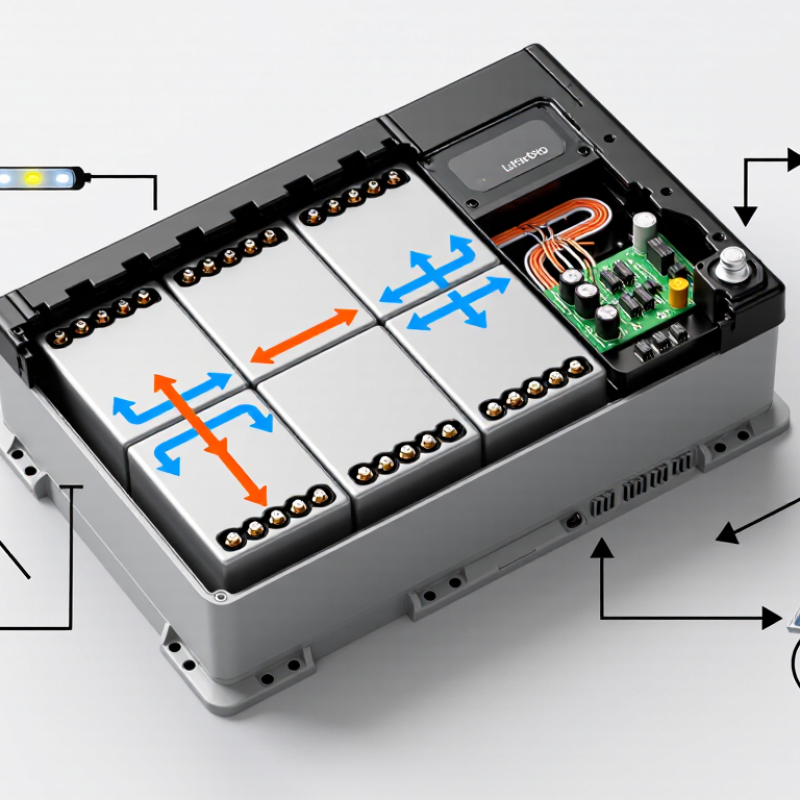
A 12V LiFePO4 battery usually contains four cells connected in series. Each cell has a nominal voltage of about 3.2 volts, giving the pack roughly 12.8 volts. That is normal. The actual voltage changes as the battery charges or supplies power, so “12V” describes its class, not a fixed reading.
Inside, the cells are linked by conductive busbars or cables, while an enclosed battery management system monitors cell voltage and temperature. It can disconnect the pack if readings exceed its operating limits, and some systems balance cells during charging. The casing protects these parts from bumps and dust, but it does not make every battery waterproof. Terminals provide the connection to a charger or load; secure, clean connections matter because a loose terminal can heat up under current.
Cell arrangement affects performance. Four cells in series raise voltage, while adding cells in parallel can increase capacity and available current, if the design supports it. Small details matter. A battery’s BMS limits, charging requirements, and temperature range vary by model, so the label and manual deserve a careful read. It is easy to focus on the cell chemistry and overlook the wiring. That can be a mistake.
How Lithium-Ion Movement Generates Electrical Current
A 12V LiFePO4 battery usually contains four lithium iron phosphate cells connected in series. Each cell averages about 3.2 volts, so the pack’s nominal voltage is roughly 12.8 volts. “Twelve-volt” is a familiar system label, not its exact operating voltage. Inside each cell, lithium ions travel through the electrolyte, while the separator blocks electrons. During discharge, lithium ions move from the graphite anode toward the iron-phosphate cathode. Electrons take a different route: through the external circuit, powering a lamp, motor, or inverter. That detour creates useful current.
Charging reverses the process. The charger drives electrons through the external circuit and lithium ions back toward the graphite electrode. A battery management system monitors cell voltage and temperature, helping keep operation within safe limits. The IEA’s Global EV Outlook 2024 reports that LFP chemistry supplied about 40% of the global electric-car battery market in 2023. That figure describes electric cars, not 12V packs, but it shows how widely the chemistry is used. The ion-flow explanation is useful, though real cells are less tidy: resistance, temperature, and aging affect how much current a battery can deliver.
How the Battery Management System Protects the Cells
A 12V LiFePO4 battery usually connects four cells in series. Each cell has a nominal voltage of about 3.2 volts, giving the pack roughly 12.8 volts. Its battery management system, or BMS, watches cell voltage, pack current, and temperature. Think of it as a small referee inside the case. It can disconnect the load or charger when readings cross set limits.
That matters because one weak cell can reach its limit before the others. The BMS may stop charging to prevent overvoltage, or cut power when a cell is too low. It can also interrupt excessive current and block charging at unsafe temperatures. Some systems balance cells by bleeding a little energy from higher-voltage cells. This is not instant repair; persistent imbalance may point to a cell or wiring problem. IEC 62619:2022 sets safety requirements for industrial lithium cells and batteries, including battery-system controls. Limits vary by cell design, so there is no single universal cutoff.
The U.S. Department of Energy’s 2022 Grid Energy Storage Technology Cost and Performance Assessment uses about 85% round-trip efficiency for lithium-ion storage systems. That figure describes the whole storage system, not the BMS alone. The BMS helps manage safe operation, but it cannot restore lost capacity or compensate for poor connections. No protection system is magic. Check the battery maker’s voltage and temperature specifications before pairing it with a charger.
What Is a 12V LiFePO4 Battery and How Does It Work? — How the Battery Management System Protects the Cells
| Topic |
Typical Information |
How the BMS Helps |
| Battery chemistry |
LiFePO4 is lithium iron phosphate, a lithium-ion battery chemistry known for its relatively stable operation and long cycle life when used within specified limits. |
Monitors cell conditions and can interrupt charging or discharging when configured safety limits are reached. |
| 12V battery construction |
A common “12V” LiFePO4 battery uses four cells connected in series. Each cell has a nominal voltage of about 3.2V, giving the pack a nominal voltage of about 12.8V. |
Checks the individual series-cell voltages, not just the battery’s overall voltage. |
| Charging voltage |
Many four-cell batteries are charged to approximately 14.4–14.6V. The correct setting depends on the battery maker’s specifications and charger profile. |
Can stop or limit charging if a cell exceeds its configured high-voltage limit. |
| Cell-voltage balance |
Small voltage differences can develop between cells during use and charging. Some packs include passive balancing, often near the upper end of charge. |
Cell monitoring and balancing help keep series cells within a suitable voltage range; balancing does not replace correct charging. |
| Over-discharge protection |
Allowable discharge voltage depends on the cell and battery design. The pack’s published limits should be followed rather than relying on a single universal cutoff value. |
Disconnects or limits the load when a cell reaches its low-voltage threshold, helping prevent excessive discharge. |
| Overcurrent and short-circuit protection |
Permitted continuous and surge current varies with battery capacity, cell design, wiring, and BMS rating. |
Can disconnect the output if current exceeds its rated or configured limit, including during a short circuit. |
| Temperature protection |
Temperature limits vary by battery model. Many LiFePO4 batteries prohibit charging below 0°C (32°F) unless designed with suitable low-temperature protection or heating. |
Temperature sensors can block charging or discharging outside the battery’s specified temperature range. |
| What the BMS cannot do |
A BMS does not increase the battery’s rated capacity or current capability, and it cannot correct unsuitable wiring, an incompatible charger, or physical damage. |
Use a charger and loads that match the battery specifications, and treat the BMS as a protection layer rather than a substitute for correct system design. |
Values and protection settings differ among battery designs. Always use the limits specified for the particular battery and its BMS.
Charging, Capacity, and Typical Uses of 12V LiFePO4 Batteries
What Is a 12V LiFePO4 Battery and How Does It Work?
Charging, Capacity, and Typical Uses of 12V LiFePO4 Batteries
A 12V LiFePO4 battery stores energy in lithium iron phosphate cells. Most contain four cells connected in series, giving a nominal voltage near 12.8 volts. A built-in battery management system monitors cell voltage and temperature. It can help prevent unsafe operating conditions, but it does not replace careful charging.
Use a charger designed for LiFePO4 batteries and follow the battery maker’s voltage and temperature guidance. A lead-acid charger may not use a suitable charging profile. Capacity is usually listed in amp-hours: a 100Ah battery at 12.8 volts stores about 1,280 watt-hours nominally. Actual usable energy depends on the battery, load, and conditions. A fridge starting in a warm van may draw more than its average rating suggests.
Tips: Check charger compatibility before connecting it. Leave some capacity in reserve, especially when powering equipment overnight. These batteries are common in camper vans, small boats, solar storage, and portable power systems. Measure the actual load if you can; estimates are useful, but they can be wrong.
12V LiFePO₄ Battery: Capacity and Energy
Estimated nominal energy at 12.8V across common battery capacities.
How it works: A 12V LiFePO₄ battery typically has a nominal voltage of about 12.8V. Energy is estimated as voltage × capacity: 50Ah ≈ 640Wh, 100Ah ≈ 1,280Wh, and 200Ah ≈ 2,560Wh. Actual usable energy depends on the battery’s specifications, load, temperature, and battery management system.
Charging and uses: Many 12V LiFePO₄ batteries use a charging voltage around 14.2–14.6V, but always follow the battery manufacturer’s guidance. Common uses include RVs, boats, solar storage, and portable power systems.

 2 Enterprise Lane, Bedford, PA 15522
  (800) 771-7139
  sales@site_040a9139-525b-4487-aedd-8b22114146ed