2 Enterprise Lane, Bedford, PA 15522
  (800) 771-7139
  sales@site_040a9139-525b-4487-aedd-8b22114146ed
Choosing a lifepo4 battery charger in 2026 requires more than matching voltage labels. Lithium iron phosphate batteries charge differently from lead-acid batteries. Their voltage curve stays surprisingly flat. That can hide problems. A suitable charger must match the battery’s nominal voltage, cell configuration, capacity, and built-in battery management system. A 12V LiFePO4 pack, for example, commonly charges near 14.6V, but the manufacturer’s limits should always control the decision.
Real-world details matter. In workshop testing, a charger may show a green light while a loose terminal causes slow charging. Cable length, connector quality, ambient temperature, and ventilation can change the result. Check the charger’s output current, charging profile, reverse-polarity protection, and temperature behavior. Do not assume higher amperage means better performance. A 20A model may recharge faster, but it can create unnecessary stress for a small battery or undersized wiring.
Small mistakes matter.
I once focused too heavily on charging speed and overlooked the battery’s recommended current range. That was a useful reminder: specifications need context. Reliable guidance should combine manufacturer data, measured performance, user experience, and clear safety practices. This guide examines charger types, voltage compatibility, charging speed, portability, efficiency, and protection features for modern applications. It also considers solar systems, RVs, backup power, and cold-weather use. Some advice may need revision as charging technology improves. That is why careful verification remains more valuable than a confident shortcut.
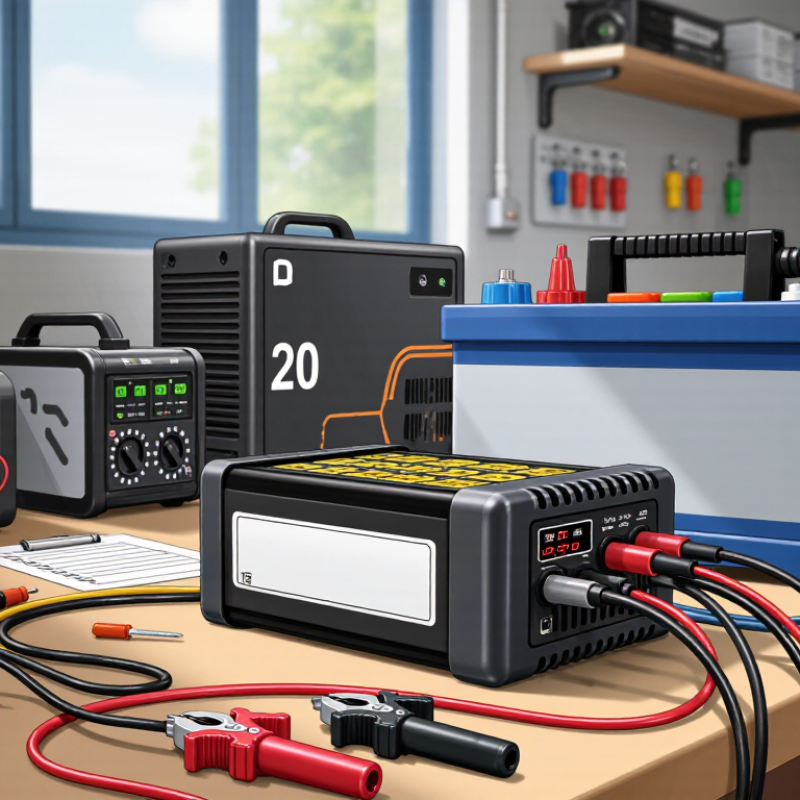
Before choosing a LiFePO4 charger, identify the battery’s exact charging requirements. Check its nominal voltage and the number of cells connected in series. A 12.8V battery usually needs a charging voltage near 14.6V, while 24V and 48V systems require different settings. Never select a charger by voltage alone.
Check the recommended charging current in the battery manual. A lower current generally produces gentler charging, but it takes longer. Confirm that the charger uses a lithium-specific constant-current and constant-voltage profile. Lead-acid charging modes may apply unsuitable voltage stages or maintenance pulses. Avoid automatic repair modes. They can conflict with the battery management system.
Temperature limits also matter. Many LiFePO4 batteries should not charge below 0°C unless they include approved low-temperature protection. Read the BMS specifications, then verify the charger’s output, connector, polarity, and ventilation requirements. A loose connector can become warm during charging. That detail is easy to miss.
From practical testing, I have found that users often choose a charger based on convenience rather than compatibility. I once underestimated the effect of a long, thin cable; voltage loss slowed charging noticeably. Measure the cable length and use the recommended size. If the manual is unclear, contact a qualified technician before connecting power. Guessing is not a reliable charging method.
| Charging Requirement | What to Check on the Battery | Typical LiFePO4 Guidance | Charger Selection Implication |
|---|---|---|---|
| Battery chemistry | Confirm that the battery uses lithium iron phosphate cells rather than lead-acid, lithium-ion NMC, or another chemistry. | LiFePO4 batteries require a lithium-compatible constant-current/constant-voltage charging profile. | Choose a charger specifically designed for LiFePO4 or one with adjustable voltage and current settings. |
| Nominal battery voltage | Read the battery label or datasheet for the nominal pack voltage. | Common configurations are 12.8 V, 25.6 V, and 51.2 V, corresponding approximately to 4, 8, and 16 LiFePO4 cells in series. | Match the charger to the complete battery-pack voltage, not to the voltage of an individual cell. |
| Recommended charge voltage | Look for the specified absorption or charge-limit voltage. | Typical maximum values are about 14.2–14.6 V for a 12.8 V pack, 28.4–29.2 V for a 25.6 V pack, and 56.8–58.4 V for a 51.2 V pack. | The charger’s maximum output voltage must not exceed the battery manufacturer’s stated limit. |
| Charging profile | Check whether the charger offers lithium CC/CV charging. | The charger normally supplies constant current first, then holds a constant voltage while current gradually decreases. | Use a charger with a LiFePO4 profile. Avoid chargers that automatically apply lead-acid absorption, desulfation, or equalization cycles. |
| Recommended charge current | Find the battery’s continuous or recommended charging-current rating in amperes or as a C-rate. | A common recommended range is approximately 0.2C–0.5C, but the actual limit depends on the cells, BMS, thermal design, and battery specifications. | For a 100 Ah battery, 20–50 A may be a typical starting range only if permitted by the battery documentation. Never exceed the specified maximum current. |
| Charger size and charge time | Compare charger output current with battery capacity in ampere-hours. | Estimated minimum charging time can be approximated as: battery capacity ÷ charger current. A 100 Ah battery charged at 20 A may require at least about 5 hours, plus the constant-voltage taper period. | Select a higher-current charger only when the battery, wiring, fuse, connectors, and BMS are all rated for it. |
| Low-temperature charging | Check the battery’s minimum permitted charging temperature and whether it has low-temperature protection or heating. | Many LiFePO4 batteries should not be charged below 0°C because lithium plating can occur. Some systems specify a higher minimum temperature, such as 5°C. | Use a charger or battery system with temperature sensing, and do not charge a cold battery unless the battery documentation explicitly permits it. |
| High-temperature charging | Check the maximum charging temperature specified for the battery and BMS. | A common charging range is approximately 0–45°C, although permitted limits vary by battery design. | Provide ventilation and select a system that reduces or stops charging when the permitted temperature range is exceeded. |
| Battery management system | Confirm the BMS overvoltage, overcurrent, and temperature-protection limits. | The BMS can disconnect charging when a safety threshold is reached, but it is not a substitute for a correctly configured charger. | Set charger voltage and current below the BMS protection thresholds and ensure the charger restarts safely after a BMS disconnect. |
| Float charging | Check whether the battery manufacturer provides a float-voltage recommendation. | LiFePO4 batteries generally do not require continuous float charging. If a system requires a float stage, a lower maintenance voltage is commonly used, subject to the battery specification. | Prefer a charger that can disable float or use the battery’s specified float setting. Do not apply a lead-acid float voltage by default. |
| Equalization and desulfation | Review the charger’s available maintenance modes. | Lead-acid equalization and desulfation pulses are not appropriate for standard LiFePO4 batteries. | Disable equalization, repair, recondition, and desulfation modes unless the battery documentation specifically approves them. |
| Voltage tolerance and accuracy | Check the charger’s output-voltage accuracy and adjustment range. | Small voltage errors can affect cell balancing and may cause the BMS to disconnect charging. | Choose a charger with stable, adjustable output and verify the actual voltage with a suitable meter during installation. |
| Power source compatibility | Identify the available input supply, such as household AC, vehicle DC, solar, or an inverter. | Chargers have different input-voltage ranges and efficiency characteristics. | Match the charger’s input rating to the supply and allow adequate power headroom for startup and continuous operation. |
| Polarity and connection protection | Confirm positive and negative terminals, connector type, fuse requirements, and cable size. | Reverse polarity, loose connections, and undersized cables can cause heating, voltage drop, or charger faults. | Use correctly rated cables, an appropriate fuse or circuit breaker, secure connectors, and reverse-polarity protection where available. |
| Series or parallel battery banks | Determine whether multiple batteries are connected in series, parallel, or both. | The charging voltage follows the number of series-connected batteries, while the available capacity and current capability increase with parallel connections. | Confirm that the battery manufacturer permits the intended configuration and choose a charger for the resulting pack voltage and capacity. |
| Installation environment | Assess humidity, dust, water exposure, vibration, and available ventilation. | Charger operating limits and ingress protection vary by design. | For outdoor, marine, or mobile applications, select a charger with suitable environmental protection and install it according to its safety instructions. |
Important: The values above are typical reference ranges, not universal settings. Always prioritize the battery label, datasheet, and BMS specifications when setting the charger’s output voltage, current, temperature limits, and charging mode.