What Are the Top Types of EV Power Stations?

An Ev Power Station can mean a single charger or a site with several charging units. For drivers, the useful difference is how quickly each type can add energy, where it fits, and what the vehicle can accept. The main options include home AC chargers, public AC posts, DC fast chargers, high-power charging hubs, and portable charging equipment. They serve different routines, not a universal ranking.

A home AC unit often suits overnight parking, when a car can remain plugged in for several hours. Public AC chargers are common near workplaces, hotels, and shopping areas, where drivers stay parked longer. DC fast chargers are designed for shorter stops on longer trips. High-power hubs can supply more energy quickly, but the actual rate depends on the vehicle, battery temperature, charger, and site connection. Numbers on a charger are not a promise.

Portable units can help in limited situations, though their output is usually modest compared with fixed equipment. Check connector compatibility, charging limits, installation requirements, and the operator’s listed power before choosing. A cold battery or busy charging site can change the experience. Small details matter. This guide compares the leading types by speed, setting, and practical trade-offs, while noting where specifications vary. Some distinctions are less tidy than a chart suggests, and real charging time may still surprise you.
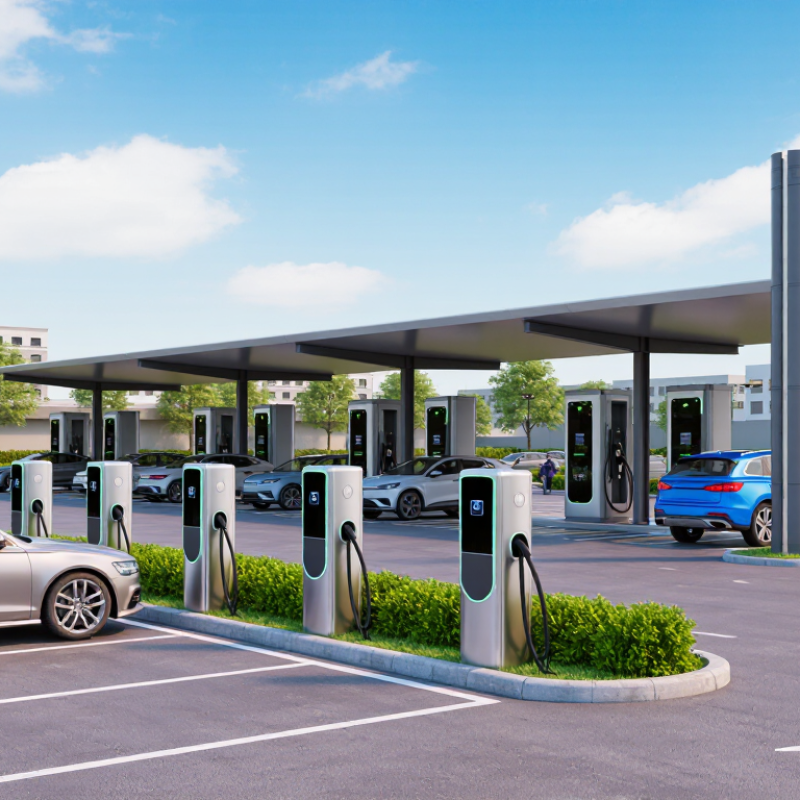
What Are the Top Types of EV Power Stations?

AC Level 1 EV Stations: About 1.4 kW on a 120 V, 12 A circuit

AC Level 1 stations use ordinary 120-volt power, making them a convenient option where higher-voltage equipment is unavailable. At 12 amps, the supply is about 1.44 kilowatts, commonly rounded to 1.4 kW. That is modest. Charging may add roughly three to five miles of driving range per hour, depending on the vehicle’s efficiency and charging losses. A cool garage, battery temperature, and the car’s onboard equipment can all affect the result.

For a short daily commute, plugging in overnight may replace much of the energy used during the day. Adding 30 miles of range could take around six to ten hours, though real results vary. Check the vehicle’s charging display rather than relying only on a simple calculation. Use a sound outlet and suitable circuit, and stop if a plug becomes unusually hot. I find Level 1 estimates easy to overstate: the arithmetic looks precise, but actual charging is not. It works best when the car sits parked for long stretches and daily driving is modest.

AC Level 1 EV Charging Power at 120 V

Power is calculated as voltage × current: at 120 V and 12 A, Level 1 charging draws about 1.44 kW (commonly rounded to 1.4 kW). Values shown are nominal electrical input power; actual power can vary with the supply voltage and vehicle.

AC Level 2 EV Stations: Up to 19.2 kW at 240 V and 80 A

Among common EV power stations, AC Level 2 stands out for overnight home charging and workplace parking. At 240 volts and 80 amps, its theoretical maximum output is 19.2 kW. That is the upper limit, not a promise of constant charging speed. The vehicle’s onboard charger may accept less power, and charging can slow as the battery fills. Small details matter.

The U.S. Department of Energy’s Alternative Fuels Data Center lists Level 2 equipment from about 2.9 to 19.2 kW, with estimated charging rates of roughly 10 to 60 miles of range per hour. Actual range varies with vehicle efficiency, temperature, and charging losses. A ten-hour session at the full 19.2 kW would theoretically deliver 192 kWh, but most vehicles cannot use that much power continuously. Check the car’s charging limit before choosing an 80-amp station.

The International Energy Agency’s Global EV Outlook 2024 reports more than four million public charging points worldwide in 2023; private AC charging offers a different convenience, with a cable ready beside the parking space. Yet the highest-rated unit is not always the best fit. Power capacity, installation limits, and daily driving needs deserve a careful second look.

DC Fast-Charging Stations: 50–350 kW for rapid public charging

DC Fast-Charging Stations: 50–350 kW for Rapid Public Charging

DC fast-charging stations deliver direct current to a vehicle’s battery, reducing charging time compared with typical AC charging. The U.S. Department of Energy’s Alternative Fuels Data Center describes DC fast chargers as commonly ranging from 50 kW to 350 kW. At a highway stop, a 150 kW unit can add useful range while a driver takes a short break. But the station’s maximum rating is not a promise of constant charging speed. Vehicle limits, battery temperature, and state of charge all affect power delivery. Often, charging slows as the battery fills. That detail is easy to overlook.

The International Energy Agency’s Global EV Outlook 2024 reports that public fast-charger installations grew by 55% worldwide in 2023. More stations help, but location and reliability matter too. A powerful charger is less useful when several vehicles share its output or a site is poorly maintained. Real-world performance can be messier than the specification sheet.

Tips: Check your vehicle’s peak DC charging rate before choosing a station. Arrive with a warm battery when practical, and avoid expecting peak power throughout the session. A little planning helps. Still, actual results vary.

Megawatt Charging Stations: MCS supports up to 3.75 MW for heavy vehicles

Megawatt charging stations are designed for heavy vehicles that cannot spend hours beside a charger. The CharIN Megawatt Charging System (MCS) technical work describes power levels up to 3.75 MW, using a design envelope of 1,250 volts and 3,000 amps. That is substantial. For a long-haul truck, faster charging could help fit energy stops into a driver’s working day. But maximum power is a technical ceiling, not a promise that every vehicle or site will receive it.

Demand is growing: the International Energy Agency’s Global EV Outlook 2024 reports that electric truck sales reached about 54,000 worldwide in 2023, up 35% from 2022. A depot planning MCS needs more than a high-power connector. Grid capacity, cooling, cable handling, vehicle compatibility, and charging schedules all matter. Real depots are messier. A thick charging cable can be awkward to position in rain, and a truck may draw less power as its battery fills. MCS therefore suits demanding routes and planned fleet hubs, but its value depends on site design and actual vehicle use. The headline number is impressive; the practical result still needs careful measurement.

FAQS

What is the maximum power of an AC Level 2 charging station?

At 240 volts and 80 amps, its theoretical maximum is 19.2 kW. Actual power may be lower.

How much range can Level 2 charging add per hour?

Estimates range from about 10 to 60 miles per hour. Vehicle efficiency, temperature, and charging losses affect the result. Small details matter.

Is an 80-amp home station right for every electric vehicle?

No. The vehicle’s onboard charger may accept less power. Check its charging limit and your site’s electrical capacity before choosing a station.

How powerful are public DC fast chargers?

They commonly range from 50 to 350 kW. A 150 kW charger can add useful range during a short stop, but peak power may not last.

Why can DC fast charging slow down during a session?

Vehicle limits, battery temperature, and charge level all affect power. Charging often slows as the battery fills. That can surprise drivers.

What does a megawatt charging system offer heavy vehicles?

It is designed for heavy vehicles and supports power levels up to 3.75 MW. This is a technical ceiling, not a guaranteed charging rate.

What should a depot consider before installing megawatt charging?

It needs suitable grid capacity, cooling, cable handling, vehicle compatibility, and charging schedules. Rain and thick cables can make setup awkward.

Are higher-rated charging stations always the best choice?

Not necessarily. Daily driving needs, vehicle limits, installation capacity, and site reliability matter. The headline number is impressive, but real performance deserves a second look.