2 Enterprise Lane, Bedford, PA 15522
  (800) 771-7139
  sales@site_040a9139-525b-4487-aedd-8b22114146ed
Choosing the right NiMH battery charger can protect your batteries, reduce wasted charging time, and make everyday devices more dependable. A good nimh battery charger should match your battery size, capacity, and typical use. It should also offer clear charging indicators and reliable safety features, such as temperature monitoring or automatic shutoff. These details matter when batteries power a camera flash, a child’s toy, or a row of household remotes. Small differences can be important.
Not every charger suits every routine. A compact model may be convenient for travel, while an independent-channel charger can handle batteries with different charge levels. Look for compatibility with common AA and AAA NiMH cells, and check the manufacturer’s guidance before charging other battery types. A display showing each cell’s status can help you spot a weak battery instead of guessing. It is useful, though not always perfectly precise. Charging speed deserves careful thought, too: faster is not automatically better, especially when heat builds up or batteries are old. In this guide, we’ll examine charger features, charging modes, safety, and practical buying considerations. You’ll learn what to compare before spending money, and which claims deserve a closer look. The best choice is not necessarily the most expensive one. It is the charger that fits your batteries and habits, while treating each cell carefully. One caveat: even a reputable charger cannot restore a worn-out battery.
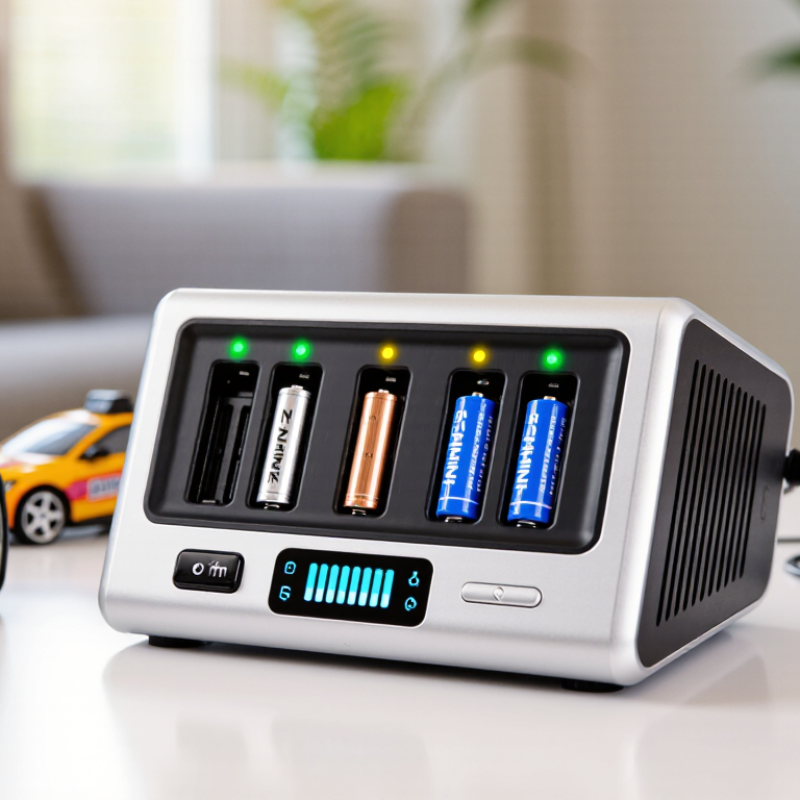
NiMH cells are not all interchangeable, even when they share the same size. AA and AAA cells differ in capacity, while standard and low-self-discharge types can behave differently during storage and repeated use. Check the cell label for capacity in milliamp-hours (mAh), chemistry, and recommended charging current. Small details matter. A charger’s user manual should explicitly support NiMH cells; a charger designed for another chemistry may use unsuitable voltage limits or termination methods.
Charging rate is often expressed as C-rate: 0.1C means current equal to one-tenth of the cell’s rated capacity. For a 2,000 mAh cell, that is 200 mA. A traditional slow-charge estimate is roughly 14–16 hours at 0.1C, but it is only a rule of thumb; real charging efficiency, cell condition, and temperature affect the result. The IEC 61951-2 standard covers portable sealed NiMH batteries and their performance testing, but it does not replace the specific charging instructions supplied for a cell. Read those instructions. A charger with individual charging channels and temperature or charge-termination monitoring can help manage mixed cells more carefully. Warm cells deserve attention. If one cell becomes noticeably hotter than its neighbors, stop and reassess the setup rather than assuming the charger is working correctly.
| Charger Feature or Type | How It Works | Best Suited For | What to Check Before Buying | Practical Guidance |
|---|---|---|---|---|
| Basic timed charger | Charges for a preset period, usually at a relatively low current, without accurately detecting when each cell is full. | Occasional charging when the charger is specifically matched to the battery type and capacity. | Supported cell sizes, recommended battery capacity range, charge duration, and automatic shutoff. | Less suitable for batteries of different capacities or partly charged cells. Follow the charger’s instructions to reduce the risk of overcharging. |
| Smart charger with charge termination | Monitors charging behavior and may use methods such as negative delta-V, temperature sensing, or a safety timer to end a charge. | Regular charging of rechargeable AA or AAA NiMH cells. | NiMH compatibility, independent monitoring of charging channels, temperature protection, and a backup timer. | A reliable choice for routine use. No single termination method is perfect in every condition, so multiple safety features are beneficial. |
| Independent-slot charger | Controls and monitors each charging bay separately rather than treating a group of cells as one combined set. | Users charging cells individually or charging cells with different remaining charge levels. | Whether each slot has its own status indicator and charge control; confirm which cell sizes and quantities can be charged. | Generally more flexible than a charger that requires cells to be charged in matched pairs. Use cells of the same type and similar capacity together in devices where possible. |
| Low-current standard charging | Uses a relatively low current over a longer period. A common reference rate is about 0.1C, where C is the cell’s rated capacity. | Charging when time is available and the battery maker permits this charging approach. | Whether the battery and charger instructions specify the current and whether the charger has a suitable timer or other cutoff. | At approximately 0.1C, charging can take roughly 14–16 hours depending on the cell and charging conditions. This is a general estimate, not a universal setting. |
| Fast charger | Charges at a higher current and relies on suitable charge-termination and safety controls. | Users who need shorter charging times and have batteries rated for the charger’s charging current. | NiMH-specific operation, temperature monitoring, automatic termination, ventilation, and compatibility with the battery maker’s current limits. | Do not assume that every NiMH cell supports fast charging. Stop using a battery that becomes unusually hot, leaks, swells, or shows other damage. |
| Low self-discharge NiMH cells | A NiMH battery design intended to retain more of its stored charge during storage than conventional NiMH cells. | Devices used intermittently, emergency supplies, and equipment stored between uses. | NiMH compatibility and the cell manufacturer’s charging instructions; the charger does not need a special brand-specific mode. | Choose based on the device’s size and capacity requirements. Storage performance varies by cell and conditions. |
| High-capacity NiMH cells | Cells with a higher rated capacity may require more charging time at the same current than lower-capacity cells. | Devices that benefit from longer runtime and are designed for the selected cell size and capacity. | The charger’s supported capacity range and whether its charging current and cutoff are appropriate for the cells. | Do not judge compatibility by capacity alone. Follow the cell maker’s instructions and avoid mixing cells with substantially different capacities in one device. |
| Multi-cell NiMH packs | Pack charging requirements depend on the number of cells, pack configuration, wiring, and any temperature sensor or protection components. | Equipment that uses a dedicated rechargeable NiMH battery pack. | Exact pack voltage and configuration, connector polarity, specified charge current, and any required temperature-sensor connection. | Use a charger designed for the exact pack specification. A charger for individual AA or AAA cells is not automatically suitable for a battery pack. |
| Refresh or discharge function | Some chargers discharge and recharge cells to help assess or restore performance in certain cases. | Occasional capacity checks or troubleshooting, when supported by the charger and battery instructions. | Whether the function is optional, its discharge limits, and whether it can be disabled for routine charging. | Routine deep discharge is generally unnecessary for NiMH cells and can add wear. A refresh cycle is not a substitute for replacing a damaged or worn-out battery. |